

You know that feeling of wistful melancholy you get when you finish something good? It hit pretty hard when the credits rolled on the Resident Evil 4 remake. I distracted myself with podcasts, for a bit; played some other games. But it kept gnawing at me. So I sat and watched a streamer’s full, blind playthrough. I burned through those 20 hours in two days straight, and I felt the same way all over again.
I could leave the review there, but it deserves more, and I think I need to write it down. Resident Evil 4 is a remake, yes, and that has all of the usual connotations. There’s nostalgia tied up in this, and expectation. But there’s a sort of truism to nostalgia that’s often neglected: it tends to be blind to flaws. Making an old game better isn’t often that difficult, because they’ve usually aged horribly. It’s just people’s memories that are out of step with reality.
Not with Resident Evil 4, though. The worst thing you can say about it is that it’s a bible for a past school of game design: it inspired so many games to come that the iterations themselves have been superseded. Present it to someone today, and the gameplay would probably feel unremarkable, because it looks like every third-person game after it. But in every other sense, it remains wholly unique.
You get those games sometimes that seem to catch lightning in a bottle. The same studio with more or less the same personnel can make four or five, and only one will be an outright classic. By some inscrutable alchemy, every element comes together to create something almost perfect, each complementing the others. It’s these games that normally get cited when we talk about ‘flow’: the state of complete immersion in a world, where your absolute investment and mastery of mechanics causes hours to pass like minutes.

Resident Evil 4 – the original Resident Evil 4 – is undeniably one of those. It’s not flawless, even by the standards of the time; the Island, the last third of the game, is horribly uneven. But the dance of combat, succession of cliff-hanger endings, variety of locations and ideas, and the absurd breadth and silliness of it all come together with baffling congruence. For what is ostensibly a horror game, it’s an experience shot through with sheer, effervescent joy.
It was a high bar, then. Higher even than the Resident Evil 2 remake, which had the purest form of nostalgia to contend with. I still think it’s worth playing the original – both for the unique griminess of PS1 horror and the content that was lost in transition – but it’s a game that feels most at home on a CRT. You can play RE4 on the Switch.
The original RE4 is probably the most ported game after Skyrim. Like Skyrim, it’s a game that both defined and defied an era. Breaking away from the rigid, sparse survival horror of its predecessors, RE4 moved from a fixed camera perspective to peering over the character’s shoulder. As Leon S. Kennedy – former rookie cop and protagonist of the second game – you embark on a quest to find and rescue the President’s daughter, kidnapped by a cult in rural Spain.
It was a switch akin to the jump from Alien to Aliens. There are horror elements in RE4, but it leans more towards stressful than spooky. Instead of dodging around enemies and conserving your ammo, the weapons here are belt-fed. A succession of blood-drenched set pieces are interwoven with one-liners, camp cutscenes, and a hoard of glittering treasures, all traded up for more elaborate guns.

It wouldn’t pay to make the remake more subtle or serious than the original, at least on paper. Go big or go home. But the remake arrives at a peculiar point in the broader Resident Evil canon. On the one hand, Resident Evil 7 revived the franchise by returning to its survival horror roots, laying the atmosphere and claustrophobia on thick. On the other, the recent high water mark was Resident Evil Village: a daft, sprawling carnival of the franchise’s greatest hits.
The approach Capcom picked in the end was to do both. The Resi 4 remake adheres almost slavishly to the structure and plot points of the original, but it’s also bigger, more tense, and more serious. There’s nothing missing that’s likely to upset people, barring a few choice lines of dialogue. Where changes have been made, it’s to heighten the drama, and support the removal of quick time events. Everything either happens in cutscenes or within the constraints of gameplay, reworking fights to fit established mechanics.
It’s easy to imagine all of this going awry, and probably harder to imagine it going well. But the love of the development team for the original is evident from the get-go. The village demo was a salve to anxious fans, and not without reason: the iconic first area is expertly realised. There can be few less forgiving introductions in gaming.
It really is notable how much is the same here, though even the simple addition of modern combat makes areas feel fresh. From the first moments, the improved ability of enemies to flank and corner you changes your appreciation of familiar spaces, and how you navigate the ladders and loops. Content that initially appears to have been cut is more often relocated, for reasons of logic or pacing. Old areas have been shifted and rearranged, resembling Escher artworks of themselves, starting at the end and arriving at the beginning.

Complementing all of this are the characters. The games since 7 have all been characterised by great voice acting and storytelling, and this one is no exception. While a few may rankle at one or two characters – and have done, loudly and cruelly – the main cast is superbly realised. Ashley in particular is a remarkable upgrade. Brilliantly played by Genevieve Buechner, she’s a sympathetic and believable companion, both sharing and battling through her trauma. She’s also a better foil to Nick Apostolides’ Leon, who is markedly better here than in the RE2 remake, and fills his predecessor’s shoes capably.
It’s probably the storytelling that most clearly elevates this game over the original. The absurdity of the events of RE4 are difficult to ground in any sort of reality, but the original didn’t even try. Leon breezily quipped his way through that entire game, while Ashley – a persistent irritant – was given little to work with. The jokes are still here in the remake, but they feel like more of a coping mechanism. Leon and Ashley are both put through the wringer, and reflect the horrors they’re subjected to. Luiz also justifies his bigger role, while big baddy Lord Saddler apes Brando’s Colonel Kurtz as a sinister, whispering ideologue.
This is a game that’s richer and more complex than its predecessor in almost every respect. That doesn’t make it better – there’s something to be said for simplicity – but for anyone who’s intimately familiar with the original, it makes it much more playable. The combat, enhanced by a suite of new animations, is consistently frantic and thrilling. The system of parries and dodges adds complexity to the old rhythm of stuns and roundhouse kicks, while an array of grabs, swings and charges make the basic enemies more varied. A handful of new enemies are sometimes enough to change the strategy for an entire area by themselves. In others, brand-new set pieces are concocted to freshen things up, and keep the veterans guessing.
Other augmentations also slot in seamlessly. Charms attached to your attaché case provide small bonuses to crafting and healing, complementing or directing your build. These are given as rewards for the Merchant’s shooting range, a small tweak that gives the mini games added value. New side quests are also introduced alongside the old medallion hunts, offering an old treasure – spinels – as currency. Many weapons and attachments can only be bought with spinels, forcing you to choose the ones that align with your playstyle.
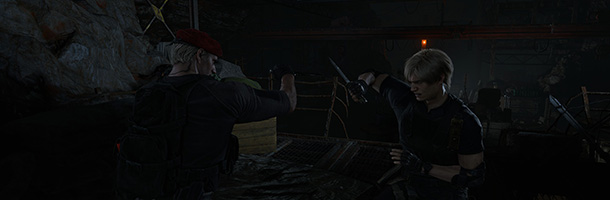
None of this is to mention the wealth of post-game content, a hallmark of the original. While the Separate Ways side story may have to wait a few months, a wealth of costumes (both unlockable and DLC) are available, as is a deluge of concept art, models and other goodies. In time-honoured tradition, there’s also exclusive content for completing the game quickly and at different difficulties and ranks, as well as the free-for-all Mercenaries mode, adding digits to an already lengthy campaign.
That’s the breakdown, then. But breaking down a game like this into its constituent parts never feels like doing it justice. It’s that strange alchemy again. The parts are extraordinary, but the whole is so much greater, so much more captivating than I can communicate.
Some of it is nostalgia, sure, or the echoes of it: revelling in the realisation of characters the original only sketched, or areas that now feel truer to life. But more of it is a feeling, a spirit, a vibe. It’s this glorious, grimy world that sucks you in and spits you out, that flings you through castles and caves and torch-lit laboratories in an explosion of chaos and colour.
Es la alegría de vivir, amigos. I think I’m getting wistful again.