
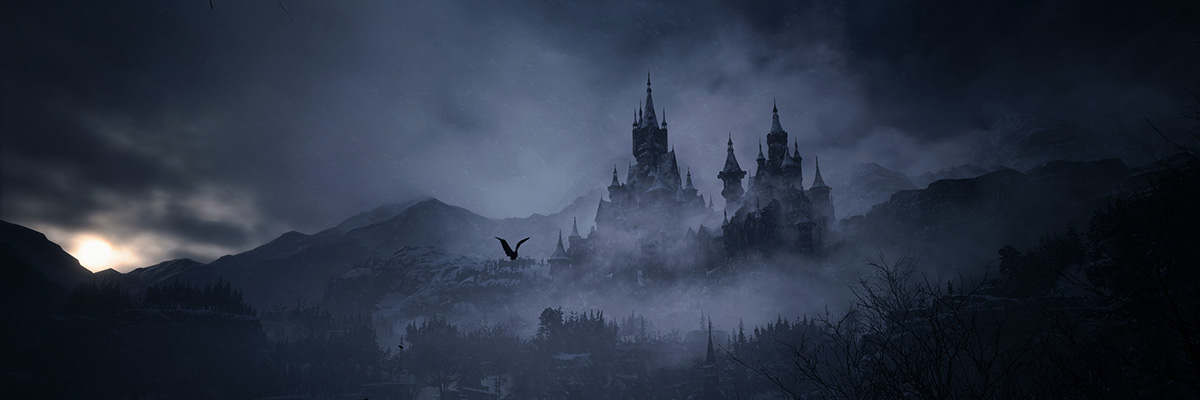
There can be few communities that are harder to please than the Resident Evil fandom. Encompassing dozens of games, movies and novels over a full quarter of a century, the series has undergone more transformations than your average season of Sailor Moon. For developers Capcom, each entry must contend with fans of every iteration, from shambling, dusty fright-fests to skull-bashing, button-mashing action. Each game has to be everything to everyone, and nobody can ever agree on what makes Resident Evil good.
By common consensus, the closest Capcom ever came to a perfect hybrid was Resident Evil 4. One of the most ported games of all time, RE4 survives because it pioneered a formula that has scarcely been bettered since. Streamlining its clunky combat, it moved beyond the cramped environments of its predecessors to embrace a carnival of locations and biomes. Fear took a backseat to tension, and the colour, quips and breakneck combat drove you through the story.
Resident Evil Village – the eighth official instalment – hasn’t been shy about its influences. If it wasn’t already evident from the trailers, Resident Evil 4 is dyed in its wool and emblazoned on its chest. There’s a village, a castle, a merchant, hidden treasure. It leaps from location to location with gleeful abandon and frightening regularity.
But there’s more introspection here, too. The series turned 25 this year, and Village has all the hallmarks of an anniversary celebration. To list everything it borrows would spoil the entire game, such is the rate at which it fires off old ideas. The net is drawn more widely, too – there’s more Outlast and Silent Hill here than we’ve seen in a Resident Evil game to date.
It’s a novel approach – can’t agree what’s best? Do everything! – but you wouldn’t say it’s a smart one. By all rights, Village should be an ugly, disjointed thing; a Frankenstein’s monster of a game, cannibalised and cobbled together. It’s a minor miracle, then, that it holds up for so long, and to such a consistently high standard. Not unlike its villains, the true monster only comes out at the end.
No game exists in a vacuum, of course. The very first Resident Evil single-handedly revived the zombie genre, though it owed as much to Alone in the Dark or Clock Tower as it did to Romero. Resident Evil 7 was lauded for reinvigorating the series, but it too leaned on old ideas, pinching from Resi 1, Texas Chainsaw and The Evil Dead. But for all that, what you borrow has never mattered so much as how well you integrate it. The whole has to exceed the sum of its parts.
In this sense, it’s hard to call Village anything less than a roaring success. While RE4 is the template, it’s iterated on smartly, and adorned with neat new touches and ideas. The old Metroidvania elements are here, as are the memorable bosses and character designs, and the treasure-driven barter system. But the first-person perspective, toned-down campness and well-honed gunplay lend greater tension to the action. Its scope allows for not one, but two dense environments full of locked doors and hidden details, both more than a match for the Raccoon City Police Department.
Make no mistake: this is much more like RE4 than anything else, and more action than survival horror. The financial success of 5 and 6 hasn’t faded from Capcom’s memory. But unlike 6, the first two-thirds or so of Village thrives in its economy and focus. Despite borrowing so much, it shapes it into something that’s cohesive and consistent, without ever lacking for content. Where RE6 lurched through four sprawling campaigns, this feels like four games in one.
Given all of this, it’s amusing how often it falls into the same traps. Like RE4 (remember the Island?), there comes a point where the rollercoaster ride slows down, and the game feels it has to fight to keep your attention. In true Capcom fashion, Village solves this by slathering the action on thick, channelling adrenaline in an attempt to power you through. It’s an artificial stimulant; a line of coke at the end of an eight-course meal. It serves a purpose, but it doesn’t exactly enhance the experience.
It’s always frustrating when a game pivots from something it was doing so well to try something worse. And yet, ultimately, it’s hard to begrudge those missteps. For what it lacked in outright scares, RE4 sticks in the memory because it was so varied. There are so many great characters, quotable lines, and memorable areas that the experience overwhelms the foibles. It’s as ramshackle and uneven as its mine cart level, but I’ll be damned if it isn’t fun from start to finish.
That’s the spirit Village embraces. It’s not the scariest Resident Evil game, not by a long shot. Nor is it the tightest, or the most daft or joyous, though all of those elements are there. But by cherry picking the best parts from 25 years of games – both its own and its competitors – it finds its own identity, and its own joie de vivre.
For a long time, the consensus has been that you simply couldn’t make a modern Resi 4 (ask series creator Shinji Mikami, who’s tried it twice). But in Village, for a solid 10 hours, it all magically comes together. And even as the game moves away from its strongest moments, the results are curious rather than boring.
Like the lavish rooms of Castle Dimitrescu, the parts in Village can look rough when you get up close. Take a step back, though, and the effect is arresting. You could call it a Greatest Hits collection, and you wouldn’t be far wrong. But if it is, it’s full binaural stereo: a glistening translation of classics and clunkers for a new era. Bold, brash, scary and silly – nothing encapsulates the entire series better. For better or worse, this might be Capcom’s magnum opus.